
OTP SMS delivers a short-lived, single-use verification code to a phone number. A reliable flow checks the code on the server, ties it to the intended action, limits guesses and resends, and rejects it after use or expiry. Receiving an SMS can help demonstrate access to a number; it does not prove a person’s identity or make an account phishing-resistant.
A customer requests a login code, waits a few seconds and taps “Send again.” The first message arrives just after the second. Which code should work? What happens if someone tries both at once? These small decisions determine whether verification feels dependable and whether the system handles abuse safely.
This guide explains how to plan an OTP SMS verification flow for a Bangladesh website or app. For service options and package information, use DianaHost’s OTP SMS service page.
Choose what the OTP is meant to verify
Start with a specific action: verify a new phone number, complete a login, recover an account or confirm an order. The same code should not authorize several unrelated actions.
| Use case | What the code can help establish | What else to consider |
|---|---|---|
| Registration | Access to the submitted phone number at that moment | Number ownership can change; this is not identity proofing |
| Login with a password | An additional possession check | SMS can be intercepted or phished; offer stronger options where appropriate |
| Password recovery | Access to a previously registered recovery number | Recovery must not bypass the account’s other protections |
| Cash-on-delivery confirmation | That someone can receive the code for the order | It does not guarantee payment, a genuine address or a fraud-free order |
| Payment or sensitive account changes | A check tied to a particular pending action | Use risk-based controls and appropriate stronger authentication |
SMS-only login is not automatically two-factor authentication. Combining a password with a separate possession factor can form a two-factor flow; two screens or two codes alone do not establish independent factors.
NIST’s digital identity guidance treats authentication over the public telephone network as restricted and describes risks such as SIM changes and number porting. SMS OTP is also not phishing-resistant. For privileged accounts and higher-risk actions, consider passkeys or other phishing-resistant methods, with a recovery process that preserves that protection.
How an OTP SMS verification flow works
Sending a text and verifying a code are separate jobs. In an application-managed flow, your backend creates the challenge and decides whether it is valid; the SMS gateway transports the message. A managed verification product may handle more of that lifecycle, so establish the responsibility split before integration.
- Receive the request. Validate the phone-number format and the action being requested. Apply abuse controls before paying to send a message.
- Create a challenge on the server. Generate the code securely and associate it with a challenge ID, account or number, purpose, expiry and attempt limits.
- Send through the approved route. Your backend uses the provider’s documented API and records its message reference.
- Check the submitted code on the server. Confirm the challenge is active, matches the intended context, has not expired and is within its attempt allowance.
- Consume the challenge once. Mark successful verification atomically so concurrent requests cannot reuse it, then authorize only the intended next step.
Never grant access because the frontend displays “verified,” the API accepted a send request or a delivery report says “delivered.” Those events are not a successful code check. Twilio’s message-status documentation illustrates the distinction between message transport states such as sent, delivered and undelivered; your provider may use different names.
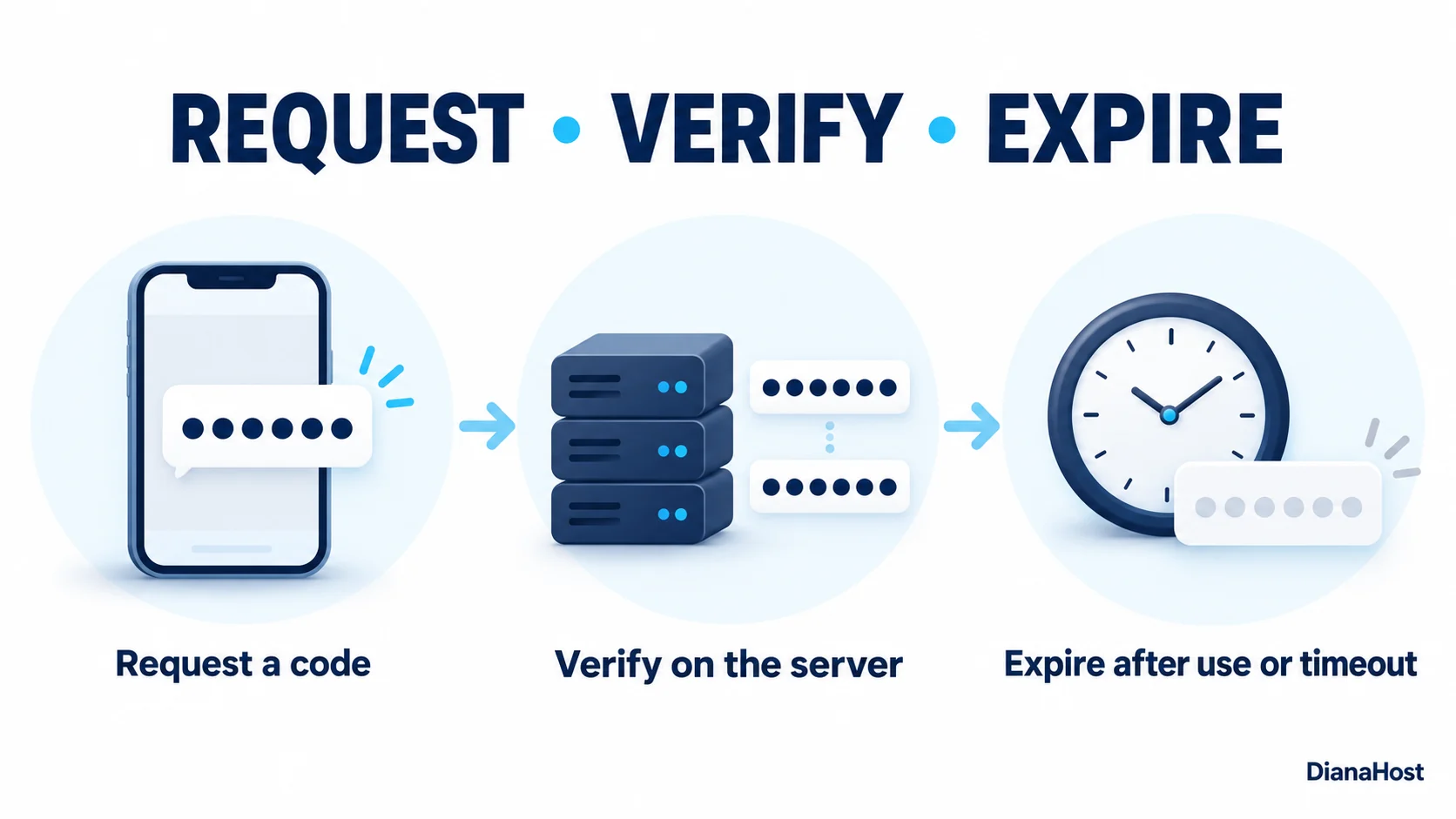
Use short-lived codes with controls around them
Generate the code with a security-grade random source
Use a cryptographically secure random-number generator. Do not derive codes from a timestamp, phone-number suffix or a predictable counter. For an SMS out-of-band secret, NIST specifies at least six decimal digits or equivalent and a validity period no longer than ten minutes. Your product can choose a shorter period that still accommodates real delivery and user-entry time.
For example, a six-digit code with a five-minute expiry can be a starting design for testing, not a universal setting or a DianaHost default. Preserve leading zeroes, and make the displayed expiry agree with the server’s actual rule.
Limit guessing, requests and repeated sending
Keep separate controls for wrong-code attempts and requests to send another message. Use limits across the challenge, account or phone number, and other risk signals. An IP-only limit is insufficient and can also inconvenience people sharing a network. Issuing a new code must not reset the account’s accumulated failed-attempt count.
Monitor sudden traffic or spend increases, and cap destinations to the countries your service actually supports. Set retry thresholds for your users, risk and delivery conditions, then review them against real traffic.
Protect stored codes and sensitive logs
Keep raw OTPs out of application logs, analytics, error reports and support tickets. Restrict access to challenge records and remove them when they are no longer needed. A plain hash alone offers limited protection for a six-digit code because the possible values are easy to enumerate. A reviewed design can use a keyed verifier, such as HMAC with a separately protected server secret, bound to the challenge context.
Use a vetted authentication library or managed verification service where it fits your requirements. The OWASP multifactor authentication guidance provides useful review points for OTP handling, factor replacement and recovery. Changing the registered phone number deserves its own secure process; a code sent only to the new number is not enough to establish control of the existing account.
Design for delayed messages and repeated taps
Show the destination in masked form and let the customer correct a mistyped number safely. Explain when another code can be requested. A visible cooldown is helpful, but enforce it on the server as well.
Decide how a resend affects the active challenge. If it issues a new code, invalidate the previous one and clearly tell the customer to use the newest code. If your verification service reuses a code during a defined window, document that behavior and keep the expiry and attempt limits consistent. Do not allow several independently valid codes to accumulate accidentally.
| What happens | Better handling |
|---|---|
| The provider request times out | Treat the result as uncertain. Use documented idempotency or status lookup where available before retrying blindly. |
| The first SMS arrives after a resend | Apply the chosen resend policy consistently and make the instructions clear. |
| A code arrives after it expires | Reject it and offer a controlled new challenge; delivery must not extend validity. |
| Two correct submissions arrive together | Allow one successful consumption using an atomic server-side operation. |
| The destination cannot receive messages | Provide a safe correction or recovery path without weakening account checks. |
Twilio’s retry guidance is a useful example of resend buffers and abuse prevention. Its product behavior is not a promise about another gateway. Confirm DianaHost’s actual request, retry and reporting behavior for the service you select.
Prepare the API integration and Bangladesh route
DianaHost’s current service page describes OTP SMS with API access and Bangla support, with your application generating the code and checking the customer’s submission. Ask the team for the documentation and credentials for your approved account. Do not adapt another provider’s endpoint, authentication header or payload and assume it will work.
Before coding, confirm these details:
- API contract: base URL, authentication method, required fields, phone-number format, timeouts, errors and rate limits.
- Verification responsibilities: whether you create and validate codes or the selected service manages those steps.
- Retry behavior: any documented idempotency support, its scope and retention window, plus a message-status lookup.
- Delivery reporting: available statuses and the documented way to authenticate callbacks and reject duplicate or forged events.
- Account controls: credential rotation, least-privilege options and IP allowlisting if supported.
- Route requirements: sender approval, content templates, permitted languages and hours, supported networks and activation lead time.
Use HTTPS/TLS with normal certificate verification for browser-to-backend requests, gateway API calls and callback endpoints. Authenticate those connections as required by the API contract. Keep gateway credentials on the backend, in an appropriate secret store. Do not ship them in mobile apps, browser JavaScript or a public repository. A client application should ask your backend to begin verification, not send arbitrary SMS directly with your account credentials.
Can an OTP be sent at any time?
Do not assume a blanket 24-hour exemption. Confirm the operating hours and content rules of your approved transactional or OTP route with DianaHost. Keep offers and unrelated promotions out of verification messages; a sale announcement does not become transactional because it contains a code. For campaign planning, see our SMS marketing guide for Bangladesh.
Does a masking sender make the message secure?
A recognizable approved sender can help customers understand who a message is from. It does not make the code phishing-resistant or prove that a request is legitimate. Sender availability and approval differ by service. Also, do not tell users to reply to a sender unless the route is confirmed to support replies.
Write a clear English or Bangla OTP message
Include the brand, purpose, code, expiry and a short warning not to share it. Avoid discounts, unnecessary links and requests to call someone with the code. On the verification screen, explain that the code belongs only in the app or website where the customer requested it.
The following examples use the fictional brand Nabopath / নবপথ, a sample code and an illustrative five-minute expiry. They are not live codes or approved DianaHost templates. Use a language permitted for your route, and make every detail match the application.
English login example
Nabopath login code: 583204. Expires in 5 minutes. Do not share it.
The exact English example uses 67 GSM-7 units: one SMS segment.
Bangla login example
নবপথ লগইন কোড: 583204। ৫ মিনিটে মেয়াদ শেষ। কাউকে দেবেন না।
The exact Bangla example uses 58 UTF-16 units: one Unicode SMS segment. Both counts exclude any provider-added text; recheck after edits.
For password recovery or a sensitive change, name that specific purpose instead of “login.” Test Bangla rendering, digit entry and copy-and-paste on the phones your customers use. Only say “We will never ask for this code” if your support process actually follows that rule.
Count segments, retries and completed verifications
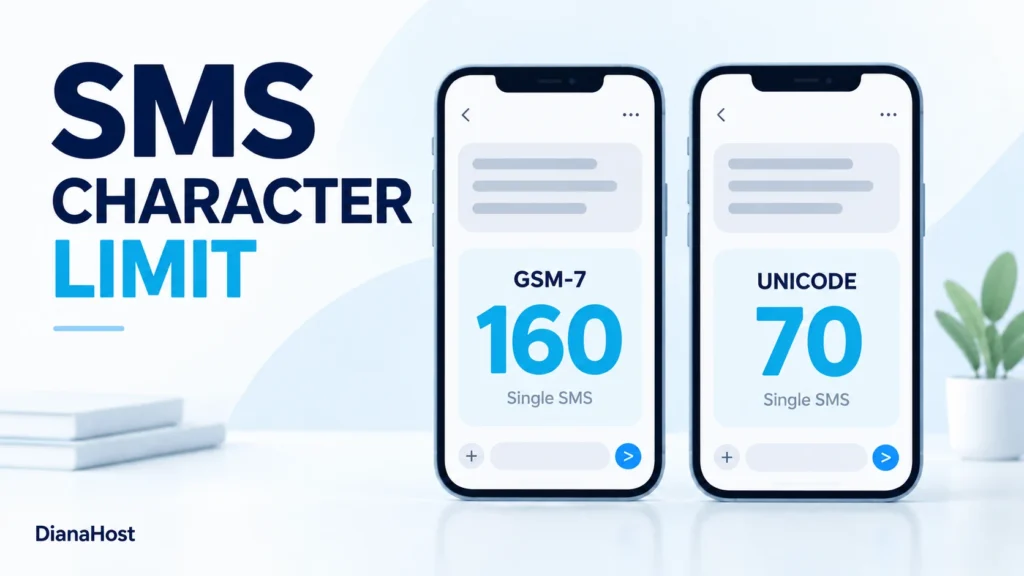
Message length affects cost even when the code is only six digits. Ordinary GSM-7 SMS typically supports 160 encoding units in one segment or 153 per part in a multipart message. Unicode messages, including Bangla, typically allow 70 units in one segment or 67 per part. Visible letters and encoding units are not always the same.
Count the complete final message, including the brand, punctuation, expiry and any provider-added text. Emoji and some punctuation can change the encoding. Our Bangla SMS character-limit guide explains the boundaries and counting examples.
Where billing is per segment, estimate billable segments × the applicable rate, then account for other charges. A useful planning scenario is 1,000 initial one-segment messages plus 150 one-segment resends: 1,150 segments before other traffic. This is an illustration, not a delivery benchmark or price quote. Ask how unsuccessful requests and delivery failures are charged.
Track cost per completed verification as well as cost per SMS. If 900 customers complete verification in that illustrative scenario, divide the total cost for that verification period by 900. State your measurement window and avoid counting repeated submissions as new successful customers.
Confirm your current package, billing model, balance alerts and replenishment process. If the account is prepaid, insufficient balance can interrupt sending. Rates, minimum volumes and payment methods vary by provider and plan. Check the current service information and request a quote for your expected volume.
Test the whole journey before launch
- Normal use: request, receive, submit and complete the intended action on representative phones and networks.
- Bad input: wrong code, wrong account or purpose, malformed number and missing challenge.
- Lifecycle: expired code, already-used code, old code after resend and concurrent successful submissions.
- Abuse: repeated sends and guesses, traffic from multiple IPs, unusual destinations and spend spikes.
- Failures: API timeout, duplicate callbacks, delayed SMS, provider errors and insufficient balance where applicable.
- Experience: masked destination, clear expiry, accessible entry fields and a safe recovery path.
- Data handling: no raw codes or API keys in logs; restricted access and a defined retention policy.
Use generic outward-facing responses where revealing whether an account exists would enable enumeration. Give the user enough guidance to recover while keeping diagnostic detail in protected operational records.
After launch, review send errors, reported delivery, time to successful verification, resend frequency and completion rate. Define each metric separately. A rise in resends could reflect delayed delivery, confusing copy or abuse; investigate before buying more volume or loosening limits.
Frequently asked questions
What is OTP SMS?
It is an SMS containing a short-lived code for a specific verification action. The application or verification service must validate it, enforce expiry and prevent reuse.
Who generates and checks the code?
In an application-managed integration, your backend does both and the gateway sends the message. A managed verification service may take on those responsibilities. Confirm what the selected DianaHost service includes.
How many digits should an OTP contain?
For SMS out-of-band authentication, NIST specifies at least six decimal digits or equivalent. Use a secure random source and pair the code with expiry and effective attempt limits; length alone is not sufficient.
Can I send an OTP in Bangla?
DianaHost’s service information lists Bangla SMS support. Confirm the route’s language and template rules, test rendering and count the final Unicode message before sending.
Does a delivered status mean the customer is verified?
No. It describes message delivery according to the gateway’s reporting. Verification succeeds only when the correct active challenge is accepted under the server’s rules.
How do I prevent duplicate OTP messages?
Use a server-enforced resend policy and stable request tracking. If the provider documents idempotency, implement it as specified. Do not blindly retry an uncertain send result or assume an arbitrary header prevents duplicates.
Is SMS OTP safe enough for every account?
No single method fits every risk. SMS faces phishing, SIM-swap and telephone-network risks. Consider phishing-resistant authentication for sensitive access and ensure recovery cannot bypass it.
Can OTP messages be sent overnight?
Confirm the permitted operation of your approved OTP route with DianaHost. Do not infer sending rules from another provider’s article, and do not mix promotional content into verification messages.
Discuss your OTP integration with DianaHost
Bring the team your use case, expected daily volume, peak request rate, target networks and sample message. Ask for the current API documentation, sender and template requirements, reporting options, billing details and the division of responsibility for generating and validating codes.
Start with DianaHost’s OTP SMS service or contact the team about your verification flow. A clear design and a representative test make the integration easier to assess before real customers depend on it.