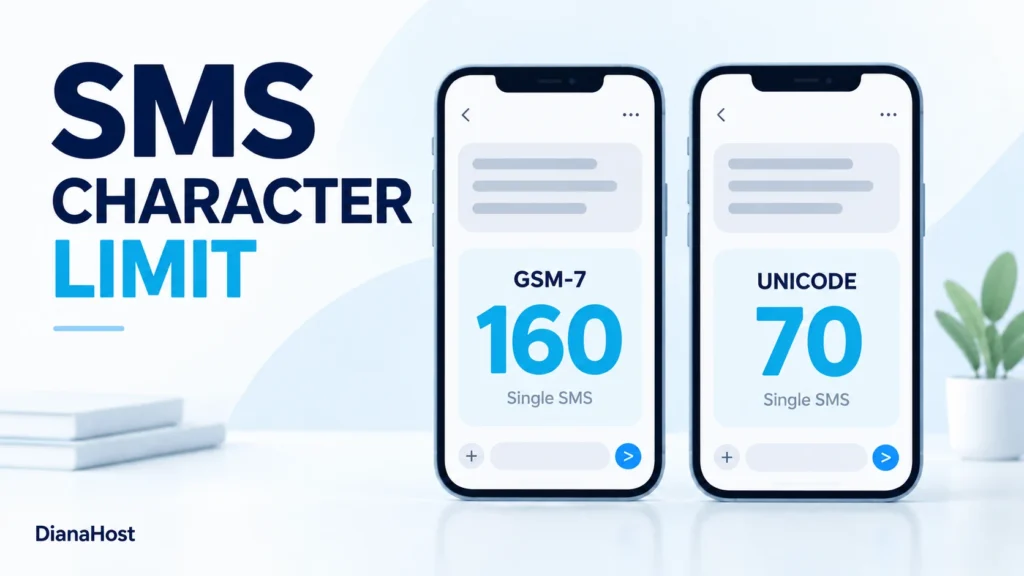

The usual Bangla SMS character limit is 70 Unicode units for a single SMS. Once the message needs multiple parts, each part normally holds 67 units. GSM-7 text allows 160 units in one part or 153 per part in a longer message. These are encoding units—not necessarily the letters you see on screen.
You write a short order update, add the customer’s name and paste in a tracking link. It still looks brief. Then the SMS counter shows two parts. What changed?
For businesses sending Bangla messages, the answer is often a small detail: a vowel sign, an extra line, a longer name or an emoji. Understanding those details makes it easier to plan a campaign without sacrificing a message your customers can actually understand.
How many characters fit in a Bangla or English SMS?
The limit depends on the message’s encoding. On typical SMS gateways, Bangla text uses Unicode encoding. English letters, numbers and many everyday punctuation marks fit in GSM-7, a compact SMS alphabet. A message containing both Bangla and English will ordinarily use Unicode for the whole text.
| Encoding | One SMS | Each multipart segment | Two-part capacity |
|---|---|---|---|
| GSM-7 | 160 | 153 | 306 |
| Unicode / Bangla | 70 | 67 | 134 |
GSM-7 uses seven bits for a basic character, which is why 160 basic characters fit into 140 bytes. Unicode SMS commonly uses 16-bit units, leaving space for 70 units. Gateways often choose the encoding from the submitted text; when using an API, check its encoding parameter and defaults as well.
An SMS carries up to 140 bytes of message data. Longer messages need a joining header, which leaves less room for text in every segment. That is why a two-part Bangla SMS normally has room for 134 units, not 140. These standard limits are explained in Twilio’s SMS character-limit documentation.
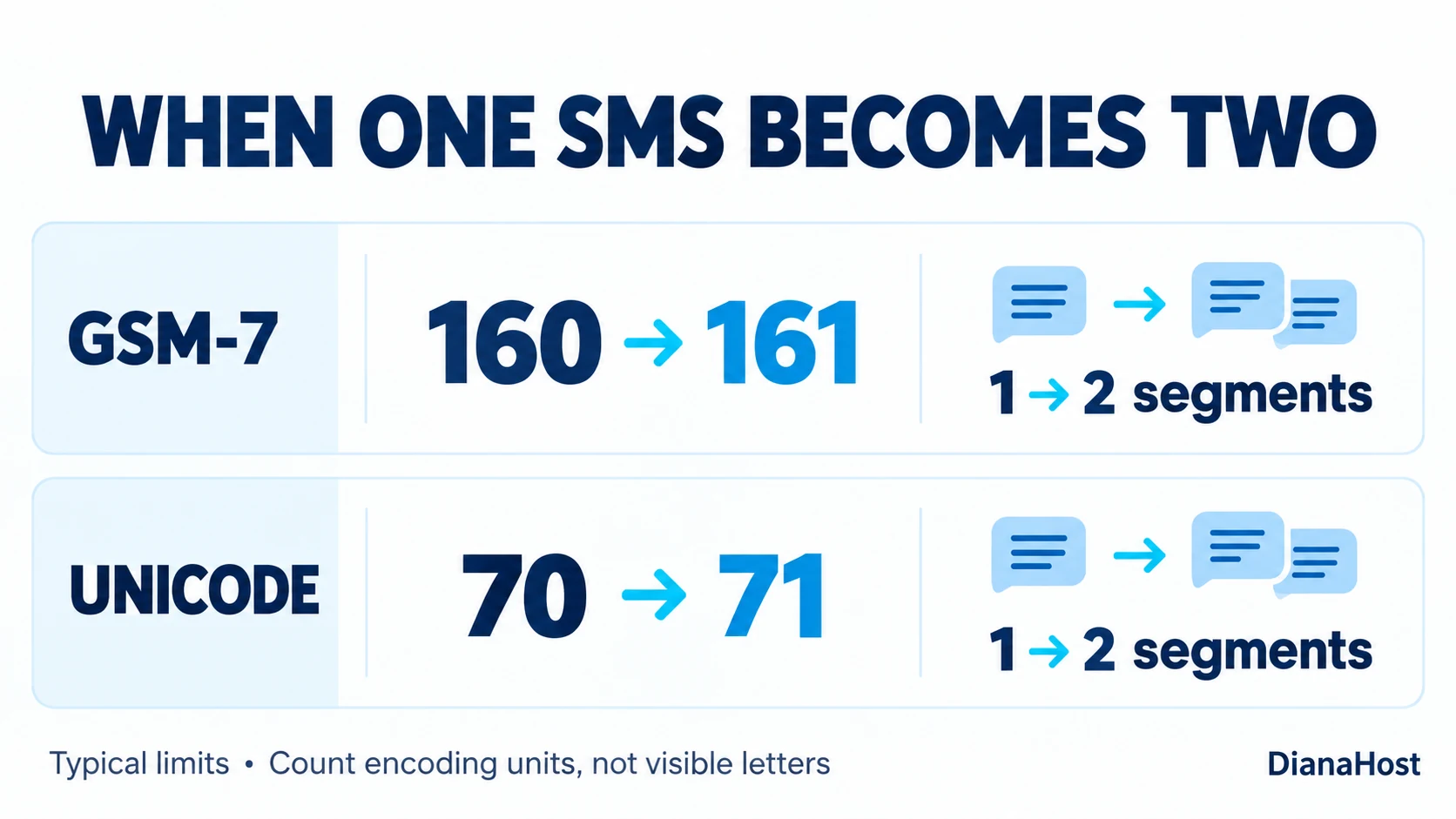
Watch the boundary: 70 Unicode units normally fit in one SMS; 71 need two. At 135 units, the message normally needs three. For GSM-7, the comparable jumps happen at 161 and 307 units. Gateway settings, routing and the handling of multi-unit characters can affect the final result, so treat your provider’s counter as the operational check.
SMS capacity chart: one to five segments
| SMS segments | GSM-7 units | Unicode / Bangla units |
|---|---|---|
| 1 | 160 | 70 |
| 2 | 306 | 134 |
| 3 | 459 | 201 |
| 4 | 612 | 268 |
| 5 | 765 | 335 |
For example, a 150-unit Bangla message exceeds the 134-unit capacity of two segments. Dividing 150 by 67 and rounding up gives three segments. This table is a capacity reference, not a promise that every gateway accepts five-part messages.
Why counting visible Bangla letters can give the wrong answer
A Bangla syllable can look like one item while containing several encoded elements. For example, কি contains a consonant and a vowel sign. A conjunct such as স্ক contains two consonants with a hasant between them. The Unicode Standard’s Bengali section explains how these elements form written Bangla.
| Text | Encoded elements | UTF-16 units |
|---|---|---|
| কি | ক + ি | 2 |
| স্ক | স + ্ + ক | 3 |
| বাংলা | ব + া + ং + ল + া | 5 |
You do not need to learn Unicode to write a useful SMS. The practical lesson is to count the final text with an SMS-aware tool, including its spaces and punctuation. A word count or a count of visible letters is not enough.
Three Bangla SMS examples, with actual counts
Here are original examples for an order workflow. Counts include the exact spaces, digits and punctuation shown, but no surrounding quotation marks or extra line breaks. They are calculated from the text’s UTF-16 units using the common 70/67 limits; they are not delivery tests.
A short order acknowledgement: 40 units, one segment
আপনার অর্ডারটি গ্রহণ করা হয়েছে। ধন্যবাদ।
This works when the customer already knows which order the message refers to. If they might have several orders, add an order reference and check the new count.
An OTP message: 51 units, one segment
আপনার OTP: 123456। কোডটি কারও সঙ্গে শেয়ার করবেন না।
This is example copy, not a production OTP template. Add your business identity and any necessary expiry information, then count again. For integration guidance, see DianaHost’s OTP SMS service guide.
A collection reminder: 99 units, two segments
প্রিয় গ্রাহক, আপনার অর্ডারটি প্রস্তুত। আজই সংগ্রহ করুন। বিস্তারিত জানতে কল করুন 01234567890 নম্বরে।
The number above is a placeholder. A shorter version is “আপনার অর্ডার প্রস্তুত। আজই সংগ্রহ করুন।” Keep the collection deadline, location or contact details whenever the customer needs them. Saving a segment is useful only if the shorter message still does its job.
Four things that unexpectedly increase your SMS count
1. One non-GSM character in an English message
An English message can switch to Unicode when you insert Bangla text, a Bangla digit such as ১, a curly apostrophe such as ’, or a typographic dash such as —. The ordinary digit 1 and hyphen - are GSM-7-compatible. Some gateways offer punctuation conversion, but you should not assume yours will. Paste the completed message into the sending system and check the encoding.
2. Symbols that take two GSM-7 units
The symbols ^ { } \ [ ] ~ | € belong to the GSM-7 extension table. Each takes two units without necessarily forcing Unicode. A message can therefore exceed one segment even when its visible character count looks safe. See AWS’s supported-character documentation for the alphabet and encoding rules.
3. Emoji that contain more than one element
Emoji need particular care. 😀 occupies two UTF-16 units, while 👨👩👧👦 occupies eleven. The family appears as one symbol on many devices, but it is a sequence of emoji joined together. The Unicode emoji specification describes these sequences.
SMS providers often label Unicode messaging “UCS-2”; emoji support may use UTF-16 surrogate pairs, which strict UCS-2 cannot represent. For everyday sending, confirm both the segment count and how the emoji renders on the route you will use. Twilio’s encoding explainer covers this distinction.
Here is a useful boundary example: 130 basic English letters and spaces fit in one GSM-7 SMS. Append 😀 without an extra space, and the text becomes 132 UTF-16 units. It normally needs two Unicode segments. Under a fixed per-segment rate, that means twice the base message charge for this example; other emoji sequences and message lengths can produce different totals.
4. Customer names, links and automatic signatures
A template is not the finished message. Replace {name}, {order_id} and other fields with realistic values before estimating cost. Check a long customer name as well as a short one. If your system adds a signature or rewrites tracking links, include the resulting text too.
For a shop sending collection notices in Dhaka, for example, adding the branch address may matter more than a greeting. Put that information into the template first; trim around it afterwards.
How do SMS segments affect campaign cost?
Where your plan charges per segment, budget for the number of billable segments across all recipients. A phone may display a multipart message as one conversation bubble even though the provider processes multiple segments.
For identical messages at one segment rate:
Estimated base charge = recipients × segments per recipient × rate per segment.
| Message length | Typical segments each | Total segments | Base charge at rate R |
|---|---|---|---|
| 70 Unicode units | 1 | 1,000 | 1,000 × R |
| 71 Unicode units | 2 | 2,000 | 2,000 × R |
| 135 Unicode units | 3 | 3,000 | 3,000 × R |
R is an illustrative rate, not a DianaHost price quote. Confirm your plan’s billing rules, taxes and other charges before funding a campaign. If personalization produces different lengths, add up the segments for the actual messages instead of assuming everyone receives a one-part SMS.
Should your business use Bangla, English or Banglish?
Choose the language your customer can understand quickly. A larger character allowance helps only when the recipient understands the message and knows what to do next.
- Bangla: useful for customers who prefer reading Bangla, local service notices and greetings for occasions such as Eid or Pohela Boishakh. Keep essential instructions clear, even if they require a second segment.
- English: useful for an English-reading audience or a familiar, concise order update or verification flow. English text keeps the GSM-7 allowance only when every character belongs to that alphabet.
- Banglish: Bangla written with Latin letters can fit GSM-7, but spelling varies and can slow readers down. Test readability with your audience. Smart punctuation or emoji can still switch the message to Unicode.
For Bangladesh campaigns reaching Grameenphone, Robi/Airtel, Banglalink or Teletalk customers, confirm current route coverage and Bangla support with your provider. The character-limit calculation alone does not establish operator coverage or guarantee delivery.
Do SMS API messages follow the same character limits?
Yes. Sending through an API does not remove the SMS capacity limit. Count the final text after your application inserts names, order references, links and any signature. An API request may transport text as UTF-8 JSON, but that does not turn an on-network Unicode SMS into a 160-unit message.
Keep the encoding setting, expanded message and segment estimate together in your application workflow. Where the gateway provides a preview or segment-count response, compare it with your calculation. If the dashboard shows a live counter, check both its encoding label and part count after the last edit. Ask support to confirm the count when these details are not visible.
DianaHost’s bulk SMS service supports API access for business systems. Confirm the requirements for your chosen route before implementing promotional messages, order notifications or OTP delivery.
How to shorten a Bangla SMS without losing its meaning
- Lead with the useful detail. Put the order status, offer, code or deadline before the greeting.
- Remove repetition. Cut a long introduction or repeated business name before removing essential instructions.
- Use concise, clear dates and amounts. “15 Oct” is short without the ambiguity of an unexplained numeric date. Keep the currency and amount understandable.
- Use a short, recognizable link. Prefer a concise URL on a domain your customers trust. Check the actual sent URL if tracking adds characters.
- Keep emoji purposeful. Bangla already uses Unicode, but an emoji still consumes units and may render differently.
- Test the result on a phone. Check meaning, formatting and the link before sending to the full list.
What should you check before sending bulk SMS?
- Decide what the customer must do. Collect an order, read an update or enter a code. Build the message around that action.
- Use the audience’s preferred language. Test Bangla and English for clarity. Do not choose hard-to-read wording just to fit a larger character allowance.
- Fill every variable. Include realistic names, dates, links, amounts and any automatic footer.
- Check encoding and segments. Use your gateway’s counter or preview. Ask support if the displayed count differs from your calculation.
- Send a small test. Review the actual wording, Bangla rendering and links on representative phones and networks before a large campaign.
- Review the sending estimate. Confirm recipient count, segment volume and the applicable rate after your final edit.
Keep the approved copy with the campaign record. That gives your team a reliable starting point the next time someone changes a name field, adds an offer or updates a link.
Frequently asked questions
Is the Bangla SMS limit 70 characters or 70 words?
It is an encoding limit, not a word limit. A single Unicode SMS typically holds 70 units. Bangla vowel signs and conjuncts mean the number of visible letters can be lower.
Can I send a Bangla SMS longer than 70 units?
Usually, yes, through multipart SMS. Under the common limit, 71–134 units use two segments and 135–201 use three. Check your gateway’s maximum length and multipart support before sending.
How many characters can one English SMS contain?
A GSM-7 SMS usually holds 160 units in one segment, or 153 per segment in a multipart message. Some extension-table symbols use two units, so 160 visible characters do not always fit.
Why does my English SMS show Unicode?
Look for Bangla characters or digits, emoji, curly quotation marks and typographic dashes. A single unsupported GSM-7 character can change the whole message’s encoding unless your gateway explicitly converts it.
Does mixing Bangla and English keep the 160-character limit?
No. Adding Bangla ordinarily makes the whole message Unicode. English letters within that message then share the Unicode capacity.
Do spaces, links and line breaks count?
Yes. They occupy space in the message. Count the final URL and the actual newline characters, especially if your software reformats the text.
Can I use a normal character counter?
A normal counter can help inspect text, but it may count visible characters or code points rather than SMS units. Use an encoding-aware SMS counter and confirm the result in your sending gateway.
Should I shorten every message to one segment?
No. Keep the details a customer needs to act correctly. A clear two-part collection reminder can be more useful than a one-part message that leaves out the pickup location.
Plan your next SMS with DianaHost
DianaHost offers bulk SMS services in Bangladesh for promotional campaigns, business notifications and OTP workflows, subject to the sender type, approval and route requirements. Share your sample message and expected sending volume with the team to discuss a suitable service and confirm how segments will be billed.